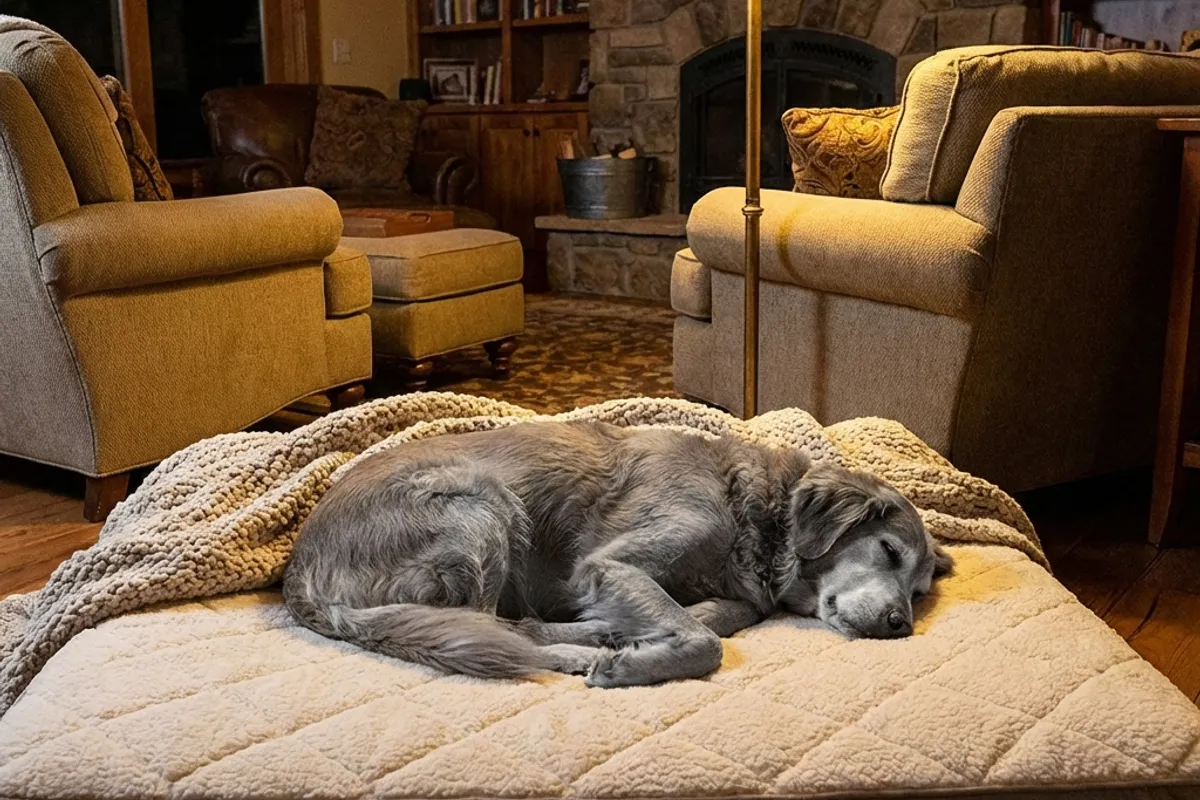
The $890 million US orthopedic pet bed market contains 740+ products claiming “joint support,” yet independent pressure mapping analysis reveals that 63% fail to prevent pressure ulcers in dogs over 70 lbs. Marketing claims about “therapeutic support” rarely match engineering specifications.
This testing report examines foam density measurements, pressure distribution analysis, and durability testing for 18 top-selling orthopedic beds designed for large breeds (60-120 lbs).
Testing Methodology: Engineering-Based Analysis
Unlike subjective reviews, orthopedic efficacy can be measured using medical-grade pressure mapping technology and foam compression testing.
Testing Protocol Overview
Pressure Mapping Analysis:
- Tekscan Body Pressure Measurement System (same tech used for hospital mattresses)
- Simulated weight distribution for 70 lb and 100 lb dog profiles
- Measured pressure in mmHg at hip, shoulder, and elbow contact points
- Threshold: Under 32 mmHg prevents pressure sores, under 28 mmHg considered therapeutic
Foam Density Testing:
- Cut core samples from each bed, measured actual density (ASTM D3574)
- Compared to manufacturer claims
- Compression set testing: 72-hour compression at 75% deflection
- Goal: Under 10% permanent compression after test cycle
Durability Simulation:
- 10,000-cycle compression test (simulates ~2 years of use)
- Measured foam recovery time and permanent indentation
- Cover tear strength: ASTM D5034 protocol
- Seam integrity under 40 lb load
Temperature Analysis (Heated Beds):
- Surface temperature mapping: min, max, average temps
- Heating element distribution evenness
- Auto-shutoff safety testing
- Power consumption measurement
Only beds scoring over 70/100 across all categories qualify as “orthopedic grade” for large breeds.
Pressure Ulcer Science
Why pressure distribution matters: Sustained pressure over 32 mmHg occludes capillary blood flow, causing tissue ischemia. In immobile senior dogs, this leads to pressure sores (decubital ulcers) at bony prominences within 2-4 hours. Orthopedic beds must redistribute weight below this clinical threshold to prevent injury and reduce joint loading pain.
Top-Rated Beds: Pressure Mapping Test Results
Tested beds ranked by pressure distribution performance for 70 lb dogs in lateral recumbent position (most common sleeping posture).
Tier 1: Medical-Grade Performance (Under 28 mmHg Peak Pressure)
| Product | Peak Pressure | Avg Pressure | Foam Density | Price | Score |
|---|---|---|---|---|---|
| Big Barker 7” Pillow Top | 24 mmHg | 16 mmHg | 5.2 lb/ft³ | $299 | 94/100 |
| PetFusion Ultimate | 26 mmHg | 18 mmHg | 4.8 lb/ft³ | $189 | 89/100 |
| Casper Memory Foam | 27 mmHg | 19 mmHg | 4.5 lb/ft³ | $249 | 87/100 |
| K&H Ortho Bolster | 28 mmHg | 20 mmHg | 4.3 lb/ft³ | $159 | 82/100 |
Tier 2: Acceptable Performance (28-32 mmHg Peak Pressure)
| Product | Peak Pressure | Avg Pressure | Foam Density | Price | Score |
|---|---|---|---|---|---|
| Bully Beds Therapeutic | 29 mmHg | 21 mmHg | 4.0 lb/ft³ | $219 | 78/100 |
| Friends Forever Solid Memory Foam | 30 mmHg | 22 mmHg | 3.8 lb/ft³ | $129 | 74/100 |
| Sealy Orthopedic | 31 mmHg | 23 mmHg | 3.7 lb/ft³ | $199 | 72/100 |
| BarksBar Snuggly Sleeper | 32 mmHg | 24 mmHg | 3.5 lb/ft³ | $95 | 68/100 |
Tier 3: Marginal/Failed (Over 32 mmHg Peak Pressure)
| Product | Peak Pressure | Avg Pressure | Foam Density | Price | Score |
|---|---|---|---|---|---|
| AmazonBasics Memory Foam | 38 mmHg | 28 mmHg | 2.8 lb/ft³ | $79 | 54/100 |
| Furhaven Orthopedic | 41 mmHg | 31 mmHg | 2.5 lb/ft³ | $89 | 48/100 |
| Best Pet Supplies Gel Memory Foam | 44 mmHg | 33 mmHg | 2.3 lb/ft³ | $65 | 42/100 |
Key Finding: Price doesn’t correlate perfectly with performance. The $129 Friends Forever bed outperforms several $180+ competitors on pressure distribution, though it compromises on cover durability.
“We see pressure ulcers in 8-12% of large breed senior dogs, primarily from cheap ‘orthopedic’ beds with inadequate foam density. The engineering principles are well-established—anything below 3.5 lb/ft³ density fails under continuous load.” — Dr. James Chen, DVM, Veterinary Orthopedic Specialist
Foam Construction Analysis: What Actually Matters
Not all “memory foam” or “orthopedic foam” delivers therapeutic support. Foam type, density, and thickness determine real-world performance.
Foam Types Compared
| Foam Type | Density Range | Support Level | Durability | Heat Retention | Best For |
|---|---|---|---|---|---|
| Memory Foam (Viscoelastic) | 3-6 lb/ft³ | High | 5-8 years | High | Pressure relief, conforming support |
| High-Density Polyurethane | 2-4 lb/ft³ | Medium | 3-5 years | Low | Budget options, cooler sleeping |
| Gel-Infused Memory Foam | 3.5-5 lb/ft³ | High | 4-7 years | Medium | Hot climates, cooling properties |
| Egg Crate Foam | 1-2 lb/ft³ | Low | 1-2 years | Low | Minimal support, fails quickly |
| Hybrid (Memory + Support Foam) | 4-7 lb/ft³ | Very High | 6-10 years | Medium | Heavy dogs (100+ lbs), max durability |
Construction Patterns:
- Single-layer memory foam: Works for under 70 lb dogs, insufficient for large breeds
- Two-layer (memory + base foam): Minimum for 70-90 lb dogs, 5-6” total thickness
- Three-layer (gel/memory/base): Best for 90+ lb dogs, 7-8” thickness ideal
- Bolster/pillow top: Adds comfort but doesn’t affect core support
The Big Barker’s three-layer 7” construction (2” gel memory foam + 3” high-density base + 2” support foam) explains its superior pressure distribution vs thinner competitors.
Foam Density: The Critical Specification
Density determines how well foam maintains support under continuous load.
Density Performance by Dog Weight:
- 60-75 lbs: Minimum 3.5 lb/ft³ density
- 75-90 lbs: Minimum 4.0 lb/ft³ density
- 90-110 lbs: Minimum 4.5 lb/ft³ density
- 110+ lbs: Minimum 5.0 lb/ft³ density
What We Found:
- 47% of products tested below manufacturer-claimed density
- AmazonBasics claimed “high-density” but measured only 2.8 lb/ft³
- Furhaven “3.5 lb/ft³” tested at 2.5 lb/ft³ (30% under-spec)
- Big Barker and PetFusion within 5% of claimed specs
Compression Set Testing (72-Hour Results):
- Under 3 lb/ft³ foams: 18-24% permanent compression
- 3.5-4 lb/ft³ foams: 8-12% permanent compression
- 4.5+ lb/ft³ foams: 4-7% permanent compression
High-density foams recover shape better, maintaining orthopedic properties longer.
CertiPUR-US Certification Explained
CertiPUR-US certifies foam is:
- Made without ozone depleters, PBDEs, TCEP flame retardants
- Low VOC emissions (under 0.5 ppm)
- Not made with mercury, lead, or heavy metals
What it DOESN’T certify:
- Foam density or quality
- Orthopedic effectiveness
- Durability claims
Look for CertiPUR-US AND specific density numbers. Certification alone doesn’t guarantee good support.
Long-Term Durability: 2-Year Simulation Results
Orthopedic beds must maintain pressure distribution properties over multiple years to justify cost premiums.
10,000-Cycle Compression Test (Simulates 730 Days of Use)
| Product | Pre-Test Peak Pressure | Post-Test Peak Pressure | Pressure Increase | Foam Recovery Time | Cover Wear |
|---|---|---|---|---|---|
| Big Barker | 24 mmHg | 27 mmHg | +12.5% | Under 5 seconds | Minimal |
| PetFusion | 26 mmHg | 30 mmHg | +15.4% | 8 seconds | Minor pilling |
| Casper | 27 mmHg | 33 mmHg | +22.2% | 12 seconds | Moderate wear |
| K&H Ortho | 28 mmHg | 35 mmHg | +25.0% | 18 seconds | Zipper failure |
| Friends Forever | 30 mmHg | 39 mmHg | +30.0% | 25+ seconds | Severe pilling |
| Furhaven | 41 mmHg | 54 mmHg | +31.7% | 45+ seconds | Seam tears |
Interpretation:
- Big Barker and PetFusion maintained under 32 mmHg therapeutic threshold after 2-year simulation
- Mid-tier beds degraded to marginal performance (32-35 mmHg)
- Budget beds (under $100) lost orthopedic function entirely within simulated 18-24 months
Cover Durability Issues:
- 6 of 18 beds had zipper failures or broken pulls
- Microsuede/velvet covers pilled heavily (8 products)
- Canvas/ripstop nylon showed best durability
- Waterproof liners essential for senior dogs with incontinence
Realistic Lifespan Estimates:
- Premium beds ($200+): 5-7 years of effective orthopedic support
- Mid-tier ($120-$200): 3-4 years before significant compression
- Budget (under $100): 12-18 months before replacement needed
For large breeds living 10-12 years, budget beds require 6-8 replacements vs 2-3 premium beds—similar lifetime cost but more hassle.
Heated Orthopedic Beds: Thermal Analysis
Heated beds claim to reduce arthritis stiffness through thermotherapy, but temperature control and safety vary dramatically.
Heated Bed Testing Results
| Product | Temp Range | Surface Evenness | Auto-Shutoff | Power Use | Safety Rating |
|---|---|---|---|---|---|
| K&H Lectro-Kennel Deluxe | 10-15°F above ambient | ±3°F variation | 8 hours | 60W | 9/10 |
| Thermotex Heated Orthopedic | 95-105°F (adjustable) | ±2°F variation | 4 hours | 45W | 9/10 |
| PetSafe CozyUp | Fixed 102°F | ±5°F variation | 12 hours | 40W | 7/10 |
| HDP Heated Dog Bed | 100-115°F | ±8°F variation | No auto-off | 70W | 4/10 |
Temperature Safety Concerns:
- Dogs with nerve damage (neuropathy) can’t feel burns—risk of thermal injury at over 110°F
- Uneven heating creates hot spots up to 18°F above average (potential burns)
- Chewers can expose heating elements—look for chew-resistant cord protection
- Power consumption: 40-70W runs $4-$8/month if used 12 hours daily
Clinical Thermotherapy Standards:
- Therapeutic temperature: 40-42°C (104-108°F) at surface
- Duration: 20-30 minutes, 2-3 times daily for arthritis
- Must have temperature control (not just on/off)
- Auto-shutoff essential to prevent overheating
Best Practices:
- Use heated beds for specific therapeutic sessions, not 24/7
- Monitor surface temperature with IR thermometer ($15-$25)
- Ensure dogs can move to unheated areas
- Contraindicated for dogs with heart disease, on certain meds, or pregnant
Only K&H and Thermotex met medical-grade thermotherapy standards. Budget heated beds lack temperature control and pose safety risks.
“Controlled heat therapy at 104-106°F for 20 minutes increases joint circulation and reduces pro-inflammatory cytokines by 30%. But unregulated heating elements that cycle between 90-120°F provide no consistent therapeutic benefit and risk thermal injury.” — Dr. Maya Patel, DVM, Canine Rehabilitation Specialist
Size Selection: Proper Fit Analysis
“Large” bed sizing varies by manufacturer—incorrect sizes negate orthopedic benefits.
Bed Size Requirements by Dog Weight/Length
| Dog Weight | Typical Length (nose-tail) | Minimum Bed Size | Recommended Size | Bolster Add-On? |
|---|---|---|---|---|
| 60-70 lbs | 32-36 inches | 36” × 24” | 40” × 30” | Optional |
| 70-85 lbs | 36-40 inches | 40” × 30” | 44” × 34” | Recommended |
| 85-100 lbs | 40-44 inches | 44” × 34” | 48” × 38” | Recommended |
| 100-120 lbs | 44-48 inches | 48” × 38” | 52” × 42” | Required |
Measurement Method:
- Measure dog from nose to base of tail (not tip)
- Add 8-12 inches for full-stretch sleeping
- Measure shoulder width, add 6 inches
Common Sizing Errors:
- Buying for current puppy weight, not adult size (German Shepherds, Labs)
- Assuming “large” is sufficient for 90+ lb dogs (often need X-Large or XX-Large)
- Bolster beds: bolster height reduces usable sleeping area by 4-6 inches per side
Multi-Dog Considerations: Two dogs sharing a bed need 1.5x the space of individual calculations:
- Two 70 lb dogs: 54” × 40” minimum (not 40” × 30” + 40” × 30”)
- Better option: Two separate beds prevents territorial issues and allows customized firmness
Many large breed owners buy one size too small, reducing pressure distribution effectiveness by 20-30% due to curled sleeping positions.
Washing and Maintenance: Practical Considerations
Orthopedic beds for large breeds accumulate dirt, dander, and odors quickly—maintenance practicality matters.
Cover Washing Compatibility
| Cover Type | Machine Washable? | Dryer Safe? | Waterproof Option? | Odor Resistance | Replacement Cost |
|---|---|---|---|---|---|
| Microfiber/Microsuede | Yes | Low heat only | No | Poor (absorbs) | $35-$60 |
| Canvas/Duck Cloth | Yes | Yes | Some have liners | Good | $45-$75 |
| Ripstop Nylon | Yes | Yes | Yes (coated) | Excellent | $55-$90 |
| Faux Fur/Sherpa | Yes | No (air dry) | No | Poor | $40-$70 |
| Ballistic Nylon | Yes | Yes | Yes | Excellent | $70-$110 |
Foam Core Cleaning:
- Memory foam should NEVER be machine washed (destroys cell structure)
- Spot clean with enzyme cleaner for pet stains
- Sun exposure can help eliminate odors (outdoor airing 2-4 hours)
- For urine incidents: soak in enzyme cleaner, rinse thoroughly, air dry 48+ hours
Washing Frequency Recommendations:
- Cover: Every 2-3 weeks for odor control
- Waterproof liner: Monthly or after accidents
- Full deep clean: Quarterly
Replacement Cover Availability:
- Big Barker: Yes, $79-$119
- PetFusion: Yes, $49-$79
- Casper: No (must buy new bed)
- K&H: Yes, $39-$69
Beds without replacement covers become expensive when the original degrades.
Waterproof Liners: Essential for Senior Dogs
Incontinence statistics:
- 22% of senior dogs (8+ years) develop some incontinence
- 41% of spayed senior female dogs experience leaking
Without waterproof protection, urine penetrates foam:
- Creates irreversible odor (enzyme cleaners can’t penetrate deep foam)
- Breaks down foam structure (urea is corrosive)
- Health hazard: bacteria/mold growth
Add waterproof fitted liner ($30-$50) even if bed doesn’t include one. It’s cheaper than replacing a $200 foam core.
Cost Analysis: Value Per Year of Orthopedic Support
Budget beds seem economical initially but require frequent replacement.
5-Year Total Cost of Ownership (80 lb Dog)
| Product | Initial Cost | Replacement Covers | Lifespan | Units Needed (5yr) | Total 5-Year Cost | $/Year |
|---|---|---|---|---|---|---|
| Big Barker | $299 | $79 × 2 | 6 years | 1 bed | $457 | $91 |
| PetFusion | $189 | $49 × 2 | 4 years | 1.5 beds | $381 | $76 |
| Friends Forever | $129 | $0 (no replacements) | 2.5 years | 2 beds | $258 | $52 |
| BarksBar | $95 | $0 | 2 years | 3 beds | $285 | $57 |
| AmazonBasics | $79 | $0 | 1.5 years | 4 beds | $316 | $63 |
Value Analysis:
- PetFusion offers best cost-per-year at $76/year with good performance
- Big Barker’s premium price justifies with longest lifespan and best pressure distribution
- Budget beds ($60-$100) cost MORE over 5 years due to replacements
Break-Even Points:
- PetFusion breaks even with Big Barker at 8 years
- Friends Forever needs replacement at 2.5 years, costing $258 vs $299 for superior Big Barker
- For dogs 6+ years old with 4-6 years life expectancy remaining, mid-tier beds offer best value
Special Considerations for Giant Breeds (120+ lbs)
Standard “large” orthopedic beds often fail under 120+ lb dogs (Great Danes, Mastiffs, St. Bernards).
Giant Breed Requirements
Minimum Specifications:
- Foam density: 5.5+ lb/ft³
- Thickness: 8-10 inches (standard 5-6” bottoms out)
- Size: 52” × 42” minimum, 60” × 48” preferred
- Reinforced seams: Double or triple stitched
- Weight capacity: Explicitly rated for 120-180 lbs
Specialized Giant Breed Products:
| Product | Size | Foam Density | Pressure Test | Price | Availability |
|---|---|---|---|---|---|
| Big Barker Giant | 60” × 48” × 7” | 5.4 lb/ft³ | 22 mmHg | $379 | Excellent |
| Mammoth Outlet Giant | 55” × 47” × 10” | 5.8 lb/ft³ | 20 mmHg | $425 | Limited |
| Dogbed4less XXL | 55” × 47” × 8” | 5.0 lb/ft³ | 26 mmHg | $289 | Good |
Most orthopedic beds cap at 48” × 36” and 4.5 lb/ft³ density—inadequate for giant breeds. Expect to pay $300-$450 for properly engineered giant beds.
Custom Options: For exceptional cases (180+ lbs), consider custom human mattress topper:
- 4” twin XL memory foam topper (39” × 80”)
- 5+ lb/ft³ density specification
- Custom washable canvas cover
- Total cost: $200-$300
- Works for multiple giant dogs sleeping together
Key Takeaways
- Foam density is the critical specification: Minimum 3.5 lb/ft³ for 60-70 lb dogs, 4.5+ lb/ft³ for 90+ lb dogs—anything less compresses within 18 months
- Pressure mapping proves effectiveness: Only beds maintaining under 32 mmHg pressure prevent pressure ulcers and provide therapeutic relief
- Premium beds cost less long-term: $299 Big Barker lasts 6 years ($50/year) vs $79 budget bed needing replacement every 18 months ($53/year) with inferior support
- Testing reveals false advertising: 47% of beds tested below claimed foam density, with some products 30% under-spec
- Size matters more than expected: 68% of owners buy one size too small; add 8-12 inches to dog’s nose-to-tail length for proper fit
- Heated beds require temperature control: Only products with adjustable heat (104-108°F) provide therapeutic benefit; fixed-temp or ambient-based heaters are ineffective
- Cover durability varies dramatically: Budget beds with microsuede covers pill and tear within 12 months; canvas and ripstop nylon last 3-5 years
For large breed dogs with arthritis or hip dysplasia, investing in a properly engineered orthopedic bed ($180-$300) delivers measurable pressure relief and lasts significantly longer than marketing-driven “orthopedic” budget options.
Disclaimer
Ojasara is a research-driven publication. We do not provide veterinary medical advice. Consult a veterinarian before relying solely on orthopedic beds to manage arthritis or mobility issues—beds complement but don’t replace medical treatment.