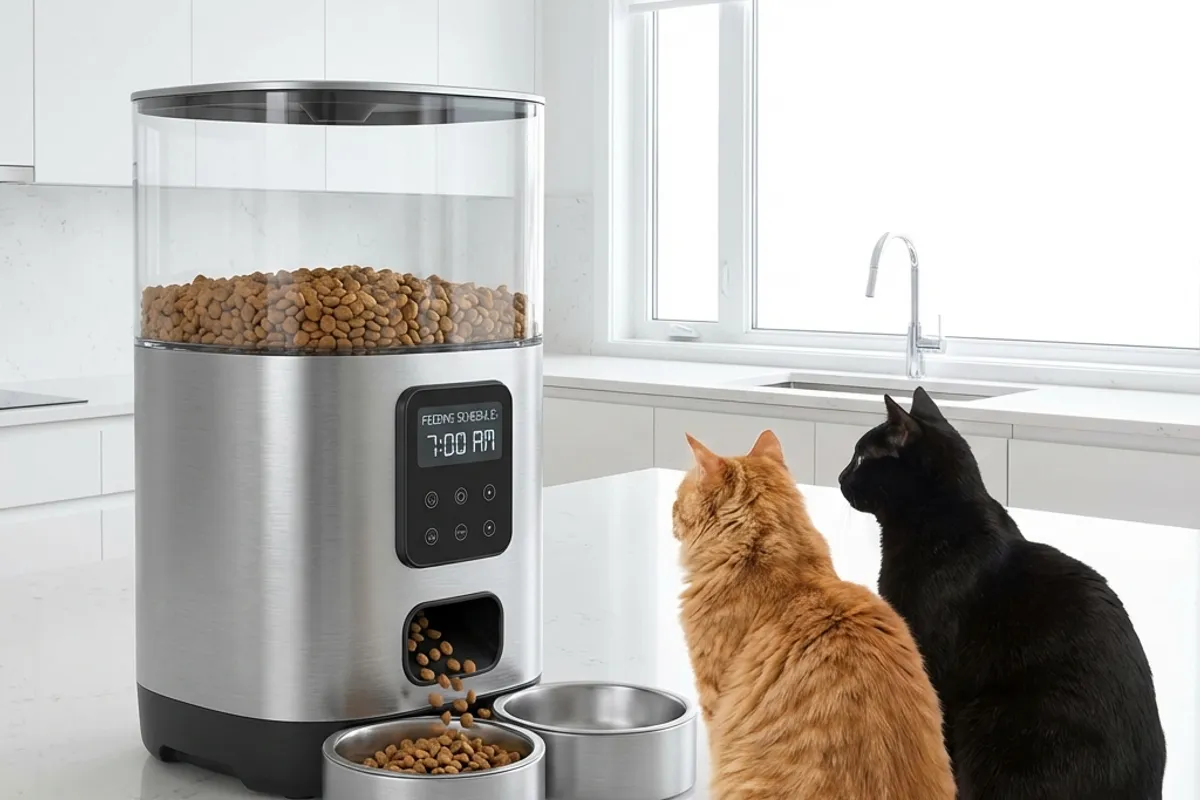
Multi-cat households face a feeding dilemma that single-cat owners never consider: how do you ensure each cat eats their appropriate portion when cats don’t respect property boundaries? One cat may need weight management while another needs extra calories. One may eat too fast while another grazes. One may be on prescription food that others shouldn’t access.
Standard automatic feeders solve the “feed cats when I’m away” problem but create new issues in multi-cat homes: dominant cats steal food, anxious cats miss meals, and portion control becomes impossible. This guide examines the technology designed specifically for multi-cat feeding challenges.
The Multi-Cat Feeding Problem
Common Scenarios
The Food Thief: One cat dominates feeding time, pushing others away from bowls and consuming more than their share.
The Prescription Diet: Cat A requires kidney diet while Cat B needs standard food—cross-eating endangers Cat A’s health.
Weight Management: Overweight cat needs restricted portions while normal-weight cats need regular meals.
The Grazer vs. The Gobbler: One cat eats slowly throughout the day while another inhales food instantly and looks for more.
Speed Eating Issues: One cat eats too fast, causing vomiting, while others eat normally.
Why Standard Feeders Fail
A regular automatic feeder dispenses food on schedule—period. It cannot:
- Identify which cat is eating
- Prevent other cats from accessing food
- Track individual consumption
- Customize portions per cat
- Close access when the wrong cat approaches
Multi-cat success requires either access control (limiting who can eat) or monitoring (tracking who ate what).
Technology Solutions
Microchip-Activated Feeders
These feeders read implanted microchips or RFID collar tags, opening only for registered cats. They’re the gold standard for preventing food theft.
How they work: A sensor reads the approaching cat’s microchip (implanted by a vet) or a paired RFID collar tag. If recognized, the lid opens. When the registered cat leaves, the lid closes, blocking other cats.
Best for: Prescription diets, weight management, multi-cat food stealing problems.
Limitations: No automatic dispensing—you manually fill bowls. Each cat needs their own feeder.
Smart Scheduled Feeders with Monitoring
These feeders dispense portions on schedules with app-based monitoring, but generally can’t control which cat eats.
How they work: Hoppers dispense programmed portions at scheduled times. Apps track when food was dispensed and (sometimes) when eating occurred.
Best for: Homes where cats eat cooperatively, portion scheduling when away.
Limitations: Cannot prevent food stealing in competitive multi-cat households.
Selective-Access Collar Systems
RFID collar systems work similarly to microchip feeders but require special collars rather than implanted chips.
How they work: Cats wear RFID-enabled collars. Feeders detect collar proximity and control access.
Best for: Cats without microchips, or when collar-based tracking is preferred.
Limitations: Collars can be lost, and some cats won’t tolerate them.
Top Multi-Cat Feeding Solutions
SureFeed Microchip Pet Feeder
Price: $179.99 Best For: Prescription diets, strict food access control
SureFeed remains the definitive solution for preventing food stealing. The microchip technology is proven across millions of installations worldwide.
Specifications:
- Access control: Microchip or RFID tag
- Bowl capacity: 400ml (dry) or 200ml (wet)
- Power: 4 C batteries (last 6+ months)
- Cats supported: Up to 32 registered per feeder
- Sealed version available: Yes ($199.99)
How It Works:
- Cat approaches feeder
- Sensor reads implanted microchip (or collar tag)
- If registered, lid opens
- Cat eats
- Cat steps away, lid closes after adjustable delay
Testing Observations: Response time under 1 second. Lid seals effectively—tested cats couldn’t nose their way in. Learning mode allows easy programming of registered cats. Some cats initially startled by lid motion but adapted within 2-3 days.
Pros:
- Highly reliable access control
- Works with existing vet-implanted microchips
- No subscription required
- Long battery life
- Training mode for introduction
- Sealed version keeps wet food fresh
Cons:
- No automatic portion dispensing
- One feeder per cat required
- Initial cost adds up for multiple cats
- Requires manual refilling
- Battery only (no plug option)
Verdict: If your core problem is food stealing or prescription diet protection, this is the solution. Nothing else matches its access control reliability.
Training Period Expected
Most cats need 3-7 days to adjust to SureFeed. Use training mode initially (lid stays open for registered cats longer), then gradually reduce delay time. Place feeder near previous feeding location. Put familiar-smelling bedding nearby. Patience during this period prevents feeding disruption.
SureFlap SureFeed Microchip Pet Feeder Connect
Price: $219.99 + Hub ($79.99) Best For: Data-driven multi-cat households
The Connect version adds WiFi capability to the standard SureFeed, enabling app-based monitoring of each cat’s eating behavior.
Additional Features:
- App tracks feeding times
- Portion consumption estimates
- Multiple feeder management
- Feeding pattern alerts
- Integrates with Sure Petcare ecosystem
Testing Observations: App provides valuable data on eating frequency and amounts. Consumption estimates are approximate but useful for trend spotting. Particularly valuable for detecting reduced appetite—an early illness sign in cats.
Best Use Case: Multi-cat homes where tracking individual eating habits matters for health management.
Additional Cost: Requires Sure Petcare Hub ($79.99) for WiFi connectivity.
Petlibro Granary Automatic Feeder
Price: $79.99 Best For: Multi-cat scheduled feeding without access control needs
Petlibro’s Granary provides excellent scheduled feeding with generous capacity, ideal for multi-cat homes where cats don’t steal from each other.
Specifications:
- Capacity: 5 liters (17+ cups of kibble)
- Meals: Up to 6 per day
- Portions: 1-50 portions per meal (1 portion ≈ 8g)
- Power: Plug-in with battery backup
- App control: Yes (WiFi)
- Camera: Optional version available
Features:
- Programmable feeding schedules
- Portion size customization
- Low food alerts
- Feeding log
- Voice recording for meal calls
- Anti-jam technology
Testing Observations: Dispensing was reliable and consistent across portion sizes. Voice recording feature helped train cats to feeding location. Large capacity reduced refill frequency significantly. App was functional and responsive.
Limitations: Any cat can eat from the bowl. No individual tracking. Not suitable when cats need separate portions or diets.
Pros:
- Large capacity
- Reliable dispensing
- Good app
- Anti-clog design
- Battery backup
- Affordable for features
Cons:
- No access control
- Can’t prevent food stealing
- No individual cat tracking
- Dry food only
Verdict: Excellent feeder for cooperative multi-cat households. Not a solution for food stealing problems.
“We spent months trying to manage our three cats’ different dietary needs with one feeder. It was constant conflict and portion confusion. Switching to three SureFeed microchip feeders cost $540 upfront but solved every problem. Each cat now eats exactly what they should, peacefully.” — Multi-cat household owner, 2025
PetSafe Smart Feed
Price: $189.99 Best For: Scheduled feeding with slow-feed options
PetSafe’s Smart Feed offers sophisticated scheduling with anti-gulp features, though without access control.
Specifications:
- Capacity: 24 cups
- Meals: Up to 12 per day
- Portions: 1/8 cup to 4 cups per meal
- Power: Plug-in with battery backup
- App control: Yes (WiFi)
Features:
- Slow feed mode (dispenses in increments)
- Flexible scheduling
- Immediate feed option via app
- Feeding history logs
- Alexa compatible
Slow Feed Benefit: For cats that eat too fast and vomit, the slow-feed mode dispenses portions in smaller increments over 15 minutes, forcing slower consumption.
Testing Observations: Slow-feed mode worked effectively—test cats couldn’t gorge. Scheduling was flexible and reliable. App was responsive. Unit is larger than competitors but capacity justified the size.
Pros:
- Slow-feed mode unique feature
- Large capacity
- Reliable operation
- Good app
- Battery backup
- Alexa integration
Cons:
- No access control
- Large footprint
- Premium price for non-access-controlled feeder
- Dry food only
Verdict: Best scheduled feeder for speed-eating cats, but doesn’t solve multi-cat access issues.
Cat Mate C500 Automatic Pet Feeder
Price: $69.99 Best For: Budget multi-meal feeding
Cat Mate’s C500 offers a simpler approach—five meal compartments with ice pack for wet food freshness.
Specifications:
- Compartments: 5 separate bowls
- Capacity: 11.5 oz per compartment
- Wet food capable: Yes (with ice pack)
- Power: 3 AA batteries
- Programming: Digital timer
Features:
- Ice pack keeps wet food fresh
- Each compartment opens independently
- Simple programming
- Battery operated
Limitations: No app, no WiFi, no access control. Each compartment opens at scheduled time—any cat can eat.
Testing Observations: Simple and reliable. Ice pack kept wet food acceptable for 12+ hours in testing. Programming less intuitive than app-based feeders. Good for short absences with wet food needs.
Pros:
- Wet food compatible
- Ice pack for freshness
- Affordable
- Simple operation
- No subscription
Cons:
- Limited to 5 meals
- No access control
- No smart features
- No app
- Manual programming only
Verdict: Budget option for wet food when cats eat cooperatively. Not a multi-cat conflict solution.
Comparison Table
| Feeder | Price | Access Control | Auto-Dispense | Wet Food | App | Best For |
|---|---|---|---|---|---|---|
| SureFeed Microchip | $180 | Yes (microchip) | No | Yes (sealed version) | No | Food stealing prevention |
| SureFeed Connect | $220 + hub | Yes (microchip) | No | Yes (sealed version) | Yes | Monitoring + access control |
| Petlibro Granary | $80 | No | Yes | No | Yes | Cooperative multi-cat |
| PetSafe Smart Feed | $190 | No | Yes | No | Yes | Speed eating cats |
| Cat Mate C500 | $70 | No | Yes (timed) | Yes | No | Budget wet food |
Multi-Cat Feeding Strategies
Strategy 1: Individual Microchip Feeders
Setup: One SureFeed per cat, placed in different locations.
Best for: Prescription diets, strict portion control, competitive cats.
Cost: $180-220 per cat
Pros: Complete control, no food stealing, individual monitoring possible.
Cons: Expensive for many cats, manual refilling, takes up space.
Strategy 2: Scheduled Feeder + Supervised Meals
Setup: Automatic feeder for free-feeding dry food, supervised wet food meals.
Best for: Cats that share dry food peacefully but compete for wet food.
Cost: $80-190 for feeder
Pros: Lower cost, simpler management.
Cons: Requires owner presence for wet food, no overnight wet feeding.
Strategy 3: Room Separation
Setup: Different feeders in different rooms, cats separated during meals.
Best for: Cats that fight over food but eat appropriately when alone.
Cost: Any feeders + baby gates or doors
Pros: Uses any feeder type, no microchip technology needed.
Cons: Requires owner intervention, limits cat movement during feeding.
Strategy 4: Combination Approach
Setup: Microchip feeder for cat with special diet, standard feeder for others.
Best for: One cat needs protection, others eat normally together.
Cost: $180 for SureFeed + $80 for standard feeder
Pros: Targets the actual problem, cost-effective.
Cons: Requires some monitoring, multiple systems.
Prescription Diet Protection is Non-Negotiable
If one cat requires a prescription diet (kidney, urinary, hypoallergenic, diabetic), there is no reliable alternative to microchip-controlled feeding. Cross-contamination from other cats eating prescription food, or the prescription cat eating standard food, can undermine treatment. Invest in SureFeed for these situations—it’s a medical necessity, not a convenience.
Wet Food Considerations
Most automatic feeders handle only dry food. For multi-cat wet food needs:
SureFeed Sealed Bowl: Keeps wet food fresh and protected.
Cat Mate C500: Ice pack keeps wet food viable for 12+ hours.
Catit PIXI Scheduled Feeder: Handles wet food with cooling.
For more wet food feeder options, see our automatic wet food feeder guide.
Recommendations by Situation
Cats stealing each other’s food
Solution: SureFeed Microchip Pet Feeder for each cat ($180 each) Result: Complete access control, problem solved
One cat on prescription diet
Solution: SureFeed for prescription cat, any feeder for others Result: Protected diet, simpler setup for cooperative cats
Multiple cats, same food, cooperative eating
Solution: Petlibro Granary ($80) Result: Automated feeding, shared access acceptable
One cat eats too fast
Solution: PetSafe Smart Feed with slow-feed mode ($190) Result: Forced slower eating, reduced vomiting
Budget multi-cat feeding, wet food needed
Solution: Cat Mate C500 ($70) Result: Scheduled wet food, no access control
Complete multi-cat monitoring and control
Solution: SureFeed Connect for each cat + Hub ($220 + $80) Result: Individual access control with app monitoring
For overall cost planning across all pet expenses, use our pet cost calculator.