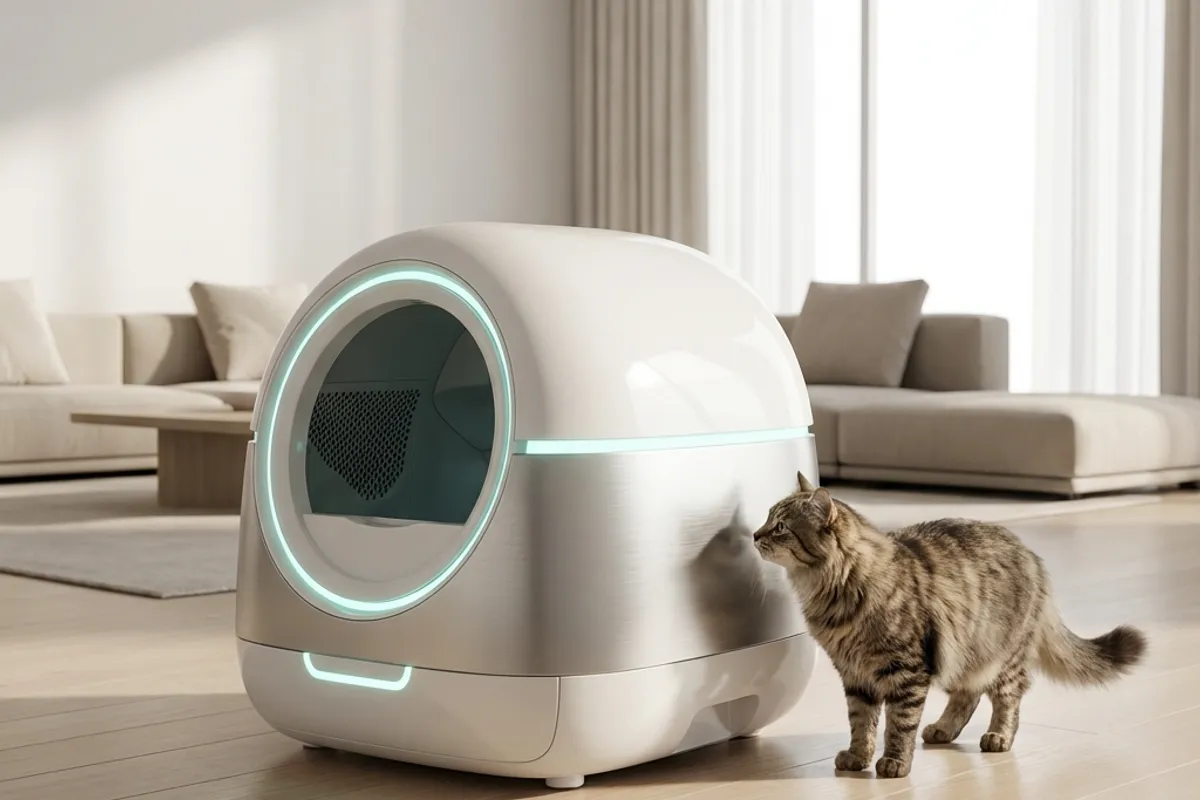
The automatic litter box represents one of pet technology’s boldest promises: never scoop cat waste again. At $500-900 for premium models, it’s also one of the most expensive cat purchases you’ll make outside of veterinary care. The question every potential buyer asks: Is a robot litter box actually worth the investment?
After analyzing operating costs, user satisfaction data, maintenance requirements, and long-term value propositions, the answer is nuanced. For some cat owners, automatic litter boxes deliver genuine quality-of-life improvements worth every dollar. For others, they’re expensive gadgets that create new problems while solving old ones.
This analysis provides the honest assessment you need—including the maintenance realities manufacturers downplay and the total cost of ownership over 5 years.
The 2026 Automatic Litter Box Market
The robot litter box category has matured significantly, with several established players and distinct product approaches:
| Model | Price (2026) | Mechanism | App Required | Multi-Cat Capacity |
|---|---|---|---|---|
| Litter-Robot 4 | $699 | Rotating globe | Optional | Up to 4 cats |
| Litter-Robot 3 Connect | $549 | Rotating globe | Yes | Up to 4 cats |
| PetSafe ScoopFree Ultra | $199 | Rake system | No | 1-2 cats |
| PetSafe ScoopFree Smart | $249 | Rake system | Yes | 1-2 cats |
| Casa Leo Leo’s Loo Too | $649 | Rotating drum | Yes | Up to 4 cats |
| Catlink Scooper | $549 | Rotating globe | Yes | Up to 3 cats |
| Petkit Pura Max | $599 | Sifting | Yes | Up to 3 cats |
| ChillX AutoEgg | $499 | Rotating globe | Yes | Up to 2 cats |
“The global automatic cat litter box market reached $780 million in 2025, with a 28% year-over-year growth rate driven by remote work normalization and premium pet product demand.” — Pet Industry Market Research, 2025
True Cost of Ownership: 5-Year Analysis
Manufacturers highlight purchase price but rarely discuss ongoing costs. Here’s the complete picture:
Litter-Robot 4: Premium Model Cost Analysis
Initial Investment:
- Unit price: $699
- Extended warranty (recommended): $99
- Total upfront: $798
Annual Operating Costs:
| Item | Frequency | Cost Per | Annual Cost |
|---|---|---|---|
| Waste drawer liners | Every 2-3 days | $0.75/bag | $100-137 |
| Carbon filter | Every 3 months | $15 | $60 |
| Clumping litter (40 lbs/month) | Monthly | $18 | $216 |
| Electricity | Continuous | ~$2/month | $24 |
| Annual Total | — | — | $400-437 |
5-Year Total Cost of Ownership: $2,800-2,985
Traditional Litter Box Comparison
Initial Investment:
- Quality covered litter box: $45
- Scoop and accessories: $15
- Total upfront: $60
Annual Operating Costs:
| Item | Frequency | Cost Per | Annual Cost |
|---|---|---|---|
| Clumping litter (40 lbs/month) | Monthly | $18 | $216 |
| Box liners (optional) | Weekly | $0.50 | $26 |
| Box replacement | Every 1-2 years | $45 | $23-45 |
| Annual Total | — | — | $265-287 |
5-Year Total Cost of Ownership: $1,385-1,495
True Cost Differential
Over 5 years, a Litter-Robot 4 costs approximately $1,400-1,500 more than traditional litter boxes. At 1,825 days, that’s about $0.80/day for the convenience of never scooping—or roughly $24/month.
What You’re Really Paying For
The premium price buys specific benefits. Understand whether these matter to you:
Benefit 1: Time Savings
Traditional box maintenance:
- Scooping: 5 minutes, 2x daily = 60+ hours/year
- Full cleaning: 20 minutes weekly = 17 hours/year
- Total: 77+ hours/year
Robot litter box maintenance:
- Empty waste drawer: 2 minutes, 2-3x weekly = 9 hours/year
- Deep cleaning: 30 minutes monthly = 6 hours/year
- Total: 15 hours/year
Time saved: ~62 hours/year
At the $24/month cost premium, you’re paying about $4.65/hour for this time savings—below minimum wage in most states. For busy professionals, this may represent genuine value.
Benefit 2: Odor Control
Robot litter boxes remove waste within minutes of deposit, dramatically reducing ammonia buildup. User surveys indicate:
- 85% of robot litter box owners report significant odor reduction
- 70% report eliminating litter box smell from their homes entirely
- Satisfaction with odor control averages 4.3/5 stars across major models
For odor-sensitive households or those in small apartments where litter boxes can’t be isolated, this benefit justifies significant cost.
Benefit 3: Health Monitoring
Smart litter boxes track usage patterns and can alert owners to potential health issues:
Litter-Robot 4 Tracking:
- Number of uses per cat (with PetID)
- Weight tracking (identifies weight changes)
- Duration in box
- Usage time patterns
What This Catches:
- Increased urination frequency (possible UTI, kidney issues)
- Decreased usage (constipation, blockage)
- Weight loss (various health concerns)
- Time pattern changes (behavioral issues)
For multi-cat households, health monitoring provides genuine veterinary value. Catching urinary issues early can save $500-3,000 in emergency vet costs.
Benefit 4: Multi-Cat Household Efficiency
Traditional litter boxes require one box per cat plus one extra. For 3 cats, that’s 4 boxes requiring daily maintenance. Robot litter boxes handle multiple cats with one unit:
| Number of Cats | Traditional Boxes Needed | Scooping Sessions Daily | Robot Boxes Needed |
|---|---|---|---|
| 1 cat | 2 boxes | 4 sessions | 1 unit |
| 2 cats | 3 boxes | 6 sessions | 1 unit |
| 3 cats | 4 boxes | 8 sessions | 1-2 units |
| 4 cats | 5 boxes | 10 sessions | 2 units |
Multi-cat households see proportionally greater value from automation.
The Maintenance Realities Manufacturers Don’t Emphasize
Before purchasing, understand the maintenance requirements:
Deep Cleaning Is Still Required
Robot litter boxes need complete disassembly and cleaning every 1-4 weeks depending on usage. This takes 20-30 minutes and involves:
- Removing and washing the globe/drum
- Cleaning sensors and base
- Replacing carbon filters
- Wiping down rubber components
- Reassembling correctly
Reality check: You’re not eliminating litter box maintenance—you’re reducing scooping and trading it for less frequent but more involved cleaning sessions.
Component Replacement
Expect to replace:
| Component | Lifespan | Replacement Cost |
|---|---|---|
| Carbon filter | 3 months | $15 |
| Waste drawer liner | Continuous | $0.75 each |
| Rubber seal/gasket | 1-2 years | $25 |
| Control panel (if failed) | 3-5 years | $75-150 |
| Motor (if failed) | 3-7 years | $100-200 |
Out-of-warranty repairs can be expensive. Extended warranties are strongly recommended.
Warranty Consideration
Most robot litter boxes carry 1-2 year warranties on parts, with motors sometimes excluded or limited. The Litter-Robot 4’s $99 extended warranty (3 years total) is generally worth purchasing given the $150-300 cost of common repairs.
Litter Type Restrictions
Most robot litter boxes require clumping clay litter. Alternative litters may not work:
| Litter Type | Compatible? | Notes |
|---|---|---|
| Clumping clay | ✅ Yes | Recommended by all manufacturers |
| Crystal litter | ⚠️ Some models | PetSafe only; not for globe-style |
| Pine pellets | ❌ No | Won’t sift properly |
| Paper-based | ❌ No | Clumps too soft |
| Corn/wheat natural | ⚠️ Limited | May cause clumping issues |
If you prefer non-clay litter for environmental or dust reasons, most robot litter boxes won’t work for you.
Model-by-Model Honest Assessment
Litter-Robot 4: The Market Leader
What It Does Well:
- Quietest operation in category (30% quieter than LR3)
- Best app and health tracking
- Most reliable mechanism
- Excellent multi-cat capacity
- Superior odor control with sealed drawer
What It Does Poorly:
- Highest price point
- Large footprint (29” tall, 22” wide)
- Still requires regular deep cleaning
- Proprietary waste bags recommended (not required)
Best For: Multi-cat households, tech-focused owners, those prioritizing reliability
Verdict: Worth the premium for multi-cat homes. For single-cat households, the Casa Leo or Catlink offer similar performance at lower cost.
PetSafe ScoopFree Ultra/Smart: Budget Option
What It Does Well:
- Lowest upfront cost ($199-249)
- Uses crystal litter trays (no scooping ever, just replace tray)
- Simple mechanism, fewer parts to fail
- Good for single-cat households
What It Does Poorly:
- Crystal litter trays are expensive ($20-25 each, lasting 2-4 weeks)
- Higher long-term cost than premium models
- Not suitable for 3+ cats
- Limited smart features (Smart model only)
- Rake mechanism can jam with larger deposits
Best For: Single-cat households testing automation, those who prefer crystal litter
Verdict: Lower upfront cost but higher operating expense. 5-year cost often exceeds Litter-Robot when accounting for tray replacements.
Casa Leo Leo’s Loo Too: Value Alternative
What It Does Well:
- Similar performance to Litter-Robot at lower price
- Attractive design options
- Good app functionality
- Quiet operation
What It Does Poorly:
- Newer company, less proven reliability track record
- Slightly smaller opening may not suit large cats
- Customer service still developing compared to Litter-Robot
Best For: Budget-conscious buyers wanting premium features
Verdict: Best value in the premium segment. Consider if $50-150 savings justifies slightly higher risk versus Litter-Robot’s established reputation.
“Consumer satisfaction rates for robot litter boxes average 78% at purchase but drop to 62% after one year, primarily due to maintenance expectations versus reality.” — Pet Technology Consumer Survey, 2025
Who Should Actually Buy a Robot Litter Box
Based on our analysis, automatic litter boxes provide clear value for:
Strong Candidates
-
Multi-cat households (3+ cats)
- Multiple boxes replaced by one or two units
- Health monitoring across cats
- Time savings multiply with cat count
-
Physically limited owners
- Those with back problems, mobility issues, or pregnancy
- Scooping elimination has genuine accessibility value
-
Small living spaces
- Superior odor control matters in studios/1-bedrooms
- One robot replaces multiple traditional boxes
-
Frequent travelers
- Automated cleaning allows longer absences
- App monitoring provides peace of mind
- For more on away-time pet care, see our digital enrichment guide
-
High-income, time-constrained households
- $24/month is trivial relative to income
- 62 hours/year is significant time savings
Poor Candidates
-
Budget-conscious single-cat owners
- Cost premium difficult to justify
- Traditional boxes work fine for one cat
-
Cats resistant to covered boxes or change
- Some cats won’t use enclosed automated boxes
- No return policy can fully mitigate this risk
-
Those with space constraints
- Robot litter boxes are large (typically 24-30” tall)
- Need accessible power outlet nearby
-
Owners who prefer natural litter
- Incompatibility with pine, paper, corn litters
- Forced into clumping clay
-
DIY/repair-averse households
- Occasional troubleshooting required
- Repairs can be complex
Making the Decision: Practical Framework
Use this framework to decide:
Step 1: Calculate Your True Daily Cost
Monthly premium ÷ 30 = Daily cost for convenience
For Litter-Robot 4: ~$24/month ÷ 30 = $0.80/day
Are you willing to pay $0.80/day to never scoop?
Step 2: Assess Your Situation
| Factor | Points For Robot | Points For Traditional |
|---|---|---|
| 3+ cats | +3 | — |
| 1-2 cats | — | +2 |
| Small living space | +2 | — |
| Large home with isolated litter area | — | +2 |
| Physical limitations | +3 | — |
| Frequent traveler | +2 | — |
| Budget constrained | — | +3 |
| Enjoy pet care tasks | — | +1 |
Score 5+: Robot litter box likely worthwhile Score 0-4: Traditional boxes probably better value
Step 3: Test Before Committing
If possible:
- Use retailer return policies (many have 90-day windows)
- Consider refurbished units for lower-risk trial
- Budget for potential return if cat rejects box
Alternative Approaches
If the robot litter box doesn’t fit, consider these upgrades:
High-Capacity Traditional Boxes
Large, well-designed traditional boxes with:
- Deep litter capacity (reduces frequency of full changes)
- Carbon filter lids (odor control)
- Antimicrobial coatings
Recommended: Catit Jumbo, PetMate Giant ($40-70)
Litter Genie Disposal System
Doesn’t automate scooping but simplifies disposal:
- Odor-sealing disposal container
- Single monthly bag change
- $25 upfront + $5/month for bags
For hydration concerns in cats, see our smart water fountain review.
Pet-Sitter or Cat Cafe for Travelers
For travel specifically, professional cat sitting may cost less than robot litter box depreciation for occasional travelers.
Long-Term Value Assessment
Over a 10-year cat lifespan:
| Approach | 10-Year Cost | Hours Spent on Litter |
|---|---|---|
| Traditional boxes | $2,770-2,990 | 770 hours |
| Robot litter box | $5,100-5,970 | 150 hours |
| Difference | $2,130-3,180 more for robot | 620 hours saved |
Effective hourly rate for convenience: $3.44-5.13/hour
If your time is worth more than $5/hour (and whose isn’t?), the robot litter box provides positive value over a cat’s lifetime—assuming the device operates reliably and you’re committed to proper maintenance.
Final Verdict
Robot litter boxes are worth the investment for:
- Multi-cat households
- Time-constrained professionals
- Small living spaces where odor control matters
- Those with physical limitations
They’re not worth it for:
- Budget-conscious single-cat owners
- Those with space for isolated traditional boxes
- Cats unlikely to adapt to enclosed boxes
- Owners who prefer non-clay litters
The technology works. The convenience is real. But the cost premium is substantial, and maintenance requirements are often undersold. Go in with clear expectations, and a robot litter box can significantly improve your daily life with cats.
For comprehensive smart home integration with pet products, see our Matter-compatible smart home guide.